
Running a Sex Offender Check in Wilson County
The official starting point is the Tennessee Sex Offender Registry, which the Tennessee Bureau of Investigation maintains for public-safety use. It supports both name and geographic searches. A person looking near a Wilson County home, school route, park, or family gathering place can use an address, city, ZIP code, county filter, or map view. Someone checking a known person can instead begin with first and last name. No fee or login is required.
Use more than one spelling when a name may have changed. Then read the full public profile. Address changes, noncompliance, map precision, and data supplied by a registering agency can affect the result. The absence of a result is not proof that no registrant is nearby. For local registration questions or suspected noncompliance, call the Wilson County Sheriff's Office at 615-444-1412. For an existing sheriff-held record, a focused Wilson County public-records request is another official channel, though confidential data remains protected.
Wilson County Registry Agency Roles
The Wilson County sheriff and TBI do different jobs. The sheriff is the designated local registration and law-enforcement contact for county residents. The agency receives required reports, answers appointment questions, and handles leads about possible failure to register or update information. TBI maintains the statewide public search and publishes data supplied through the registration system. A profile's agency and last-update fields help show which office most recently handled the entry.
The official sheriff directory lists the Wilson County Sheriff's Office at the Criminal Justice Center, 115 E. High Street, Lebanon, Tennessee 37087, with a main number of 615-444-1412. County and sheriff materials sometimes use 105 E. High Street on letterhead, so callers should confirm an address before mailing. The county facility page confirms that the sheriff is housed in the Criminal Justice Center complex.
Report a suspected compliance issue to law enforcement. Do not approach a person, publish an accusation, or try to enforce registry duties yourself.
Searching the Tennessee Sex Offender Registry
TBI's public registry offers separate name and location modes. County filtering can narrow a broad search to Wilson County, while an address search is better for a specific place. The live JavaScript interface controls its exact radius choices, so choose from the options shown rather than assuming a set distance. Map and list views present the same search from different angles. A list is often easier for comparing status and names; the map supplies place context.
- Open the official TBI registry. Select the name mode or the location and address mode.
- Enter a first and last name, or supply an address, city, ZIP code, or Wilson County filter. Pick a recognized address match when the site prompts for one.
- Run the search, then switch between list and map views when place context helps. Use clear or reset before trying another spelling or location.
- Open the likely profile and compare its identifiers, classification, status, registering agency, offense, and update details. Do not match a person from a shared name alone.
| Field Label | Type | Required | Notes |
|---|---|---|---|
| Last Name | Text | Principal name input | Try verified spelling variants separately. |
| First Name | Text | Optional | Use with a last name to narrow results. |
| City or ZIP | Text or dropdown | Optional | Narrows a Tennessee place search. |
| County | Dropdown | Optional | Select Wilson from the Tennessee county list. |
| Address and Radius | Geocoder and dropdown | Required in proximity mode | Choose a recognized address and a live radius option. |
| Map or List | View toggle | No | Changes the way geographic results appear. |
The official TBI registry search screen shows the correct public entry point without requiring a private-person example.
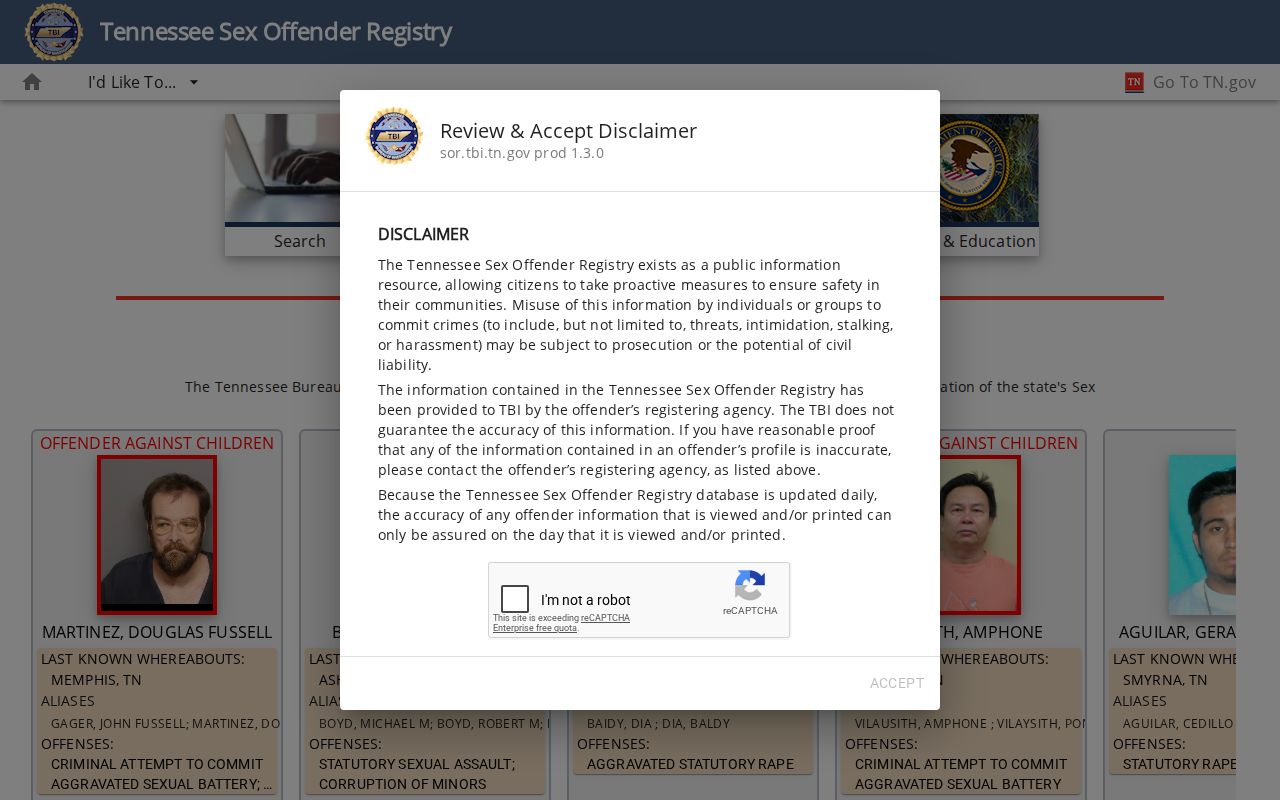
The search form is the right place to begin a Wilson County registry lookup, but each result still needs a full-profile review.
Wilson County Cross-State Registry Checks
A Tennessee search is only one layer when a person or address has ties beyond Wilson County. The U.S. Department of Justice operates the National Sex Offender Public Website, or NSOPW, as a gateway to participating jurisdictions. It is useful when someone may have moved across a state line, when travel takes a family beyond Tennessee, or when a name search should cover more than one jurisdiction. NSOPW does not replace the source registry. It points searchers across state, territorial, and tribal systems that may use different terms and update practices.
The official NSOPW interface provides the national search layer assigned to this Wilson County check.
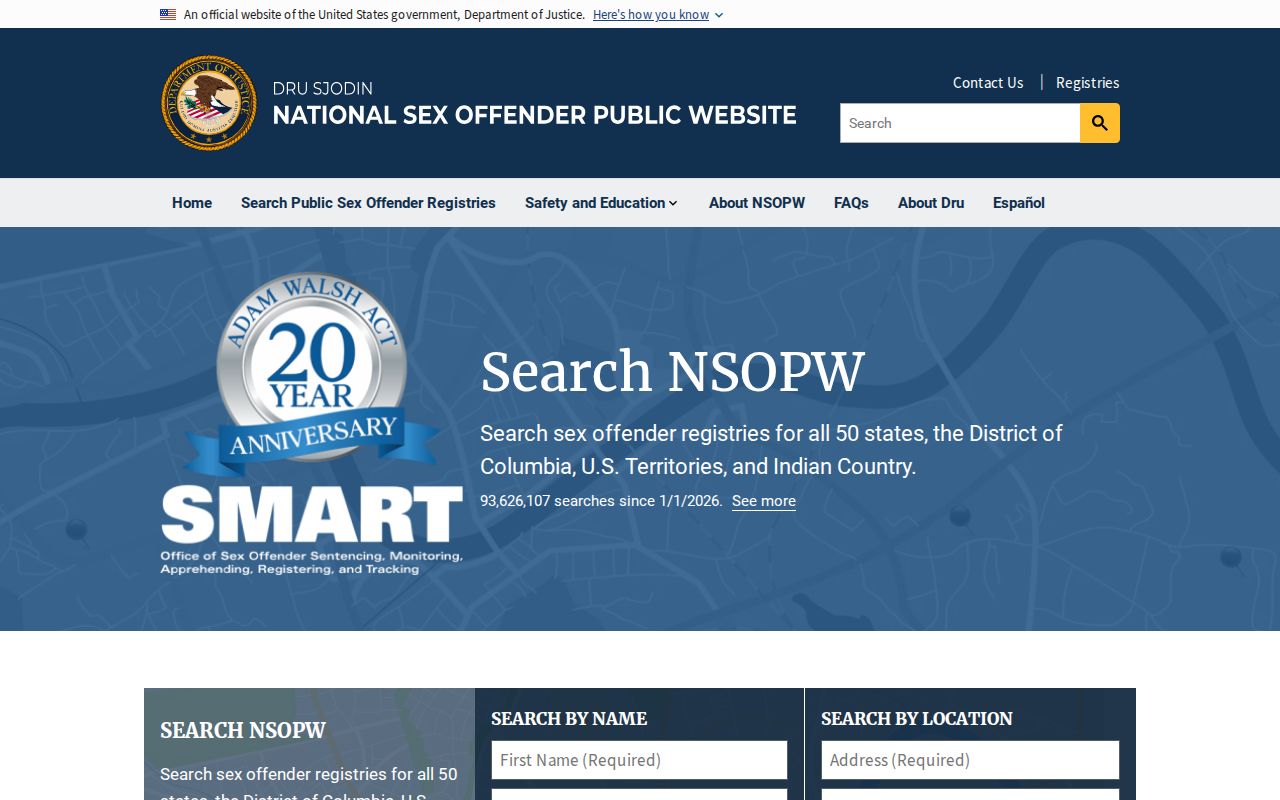
Follow a national result back to the participating jurisdiction's current profile, then confirm key facts with its registering agency.
For a Wilson County address, the TBI profile and Wilson County sheriff remain the local sources. National coverage adds reach, not a guarantee of completeness. Use the person's known identifiers and inspect the update information before drawing a conclusion.
What a Registry Profile Shows
A public profile joins identity, classification, status, address, offense, and agency data in one record. It may show a photograph; aliases; age or date of birth; sex and race; height, weight, eye color, and hair color; and scars, marks, or tattoos. Address fields can include primary and secondary residence information. Offense fields can identify the offense, statute or jurisdiction, and conviction facts. Some public records may also show school, vehicle, or other data when release rules allow it.
| Name and Aliases | Identifying names associated with the registry entry; compare more than a shared name. |
|---|---|
| Photo and Description | Photograph and physical traits such as height, weight, hair, eyes, and identifying marks. |
| Registered Address | Primary or secondary residence information released on the public profile. |
| Offense and Statute | Offense description, jurisdiction or statute, and available conviction information. |
| Classification | Tennessee category shown as Sexual or Violent, not a federal tier label. |
| Registration Status | Values may include active, absconder, incarcerated, moved to another state, or another defined status. |
| Agency and Update | The agency and officer tied to the last update, plus the type or date of a report when public. |
Status needs context. An inactive entry may reflect incarceration, a move, deportation, death, or a juvenile status rather than a simple end to all duties. The integrated state help also defines reporting events such as initial registration, annual or quarterly reporting, and an information update. Not every internal field must appear on the public TBI profile.
Note: Public profile data supports safety planning, but update dates and source-agency fields should be checked before relying on an address or status.
Wilson County Registry Versus Jail Data
A registry listing is not the Wilson County jail roster. Registry status describes a person's place in Tennessee's registration system. Jail data answers whether someone is in current county custody and may include booking or bond information. A profile marked inactive because of incarceration does not identify the Wilson County jail as the place of confinement unless the record says so. Likewise, a person can have an active registry duty while living in the community and have no current jail record.
Wilson County does not publish a confirmed county-hosted inmate search in the official sources reviewed. Current local custody questions therefore go to the sheriff at 615-444-1412, the Criminal Justice Center counter, or a focused request for an existing booking record. Tennessee's TDOC locator covers felony custody or supervision after a transfer into the state system, not the local jail population. Keeping these channels separate prevents a registry status from being mistaken for a new arrest or present confinement.
Registration Requirements and Levels in Tennessee
Tennessee uses statutory labels rather than presenting every person as federal Tier I, II, or III. The two central adult classifications are sexual offender and violent sexual offender. Reporting frequency and removal rules differ. The category, offense, number of qualifying convictions, victim age, later convictions, and compliance history can all matter. A ten-year point is only the first time some sexual offenders may request termination after the sentence expires. It does not remove a record by itself.
| Level / Tier | Duration | Verification Frequency |
|---|---|---|
| Sexual offender | If not otherwise lifetime, may request termination ten years after sentence expiration; approval is not automatic | Annual in-person reporting and verification |
| Violent sexual offender | Lifetime registration | In person in March, June, September, and December |
| Two or more qualifying convictions | Lifetime registration | Frequency follows the applicable classification |
| Registrant whose victim was under 13 | Lifetime registration | Statutory reporting schedule applies |
| Violent juvenile sexual offender | Controlled by juvenile provisions and court status | At least once in March, June, September, and December |
The official TBI registry information and law library supplies the current definitions and statutes.
The law library matters because Wilson County registration duties turn on the actual statutory category, not a simplified tier assumption.
Wilson County Registry Residence Rules
Tennessee residence restrictions are tied to a registrant's offense and status. Covered people may face 1,000-foot rules involving schools, child-care sites, parks, playgrounds, and other places named in T.C.A. § 40-39-211. The rule should not be reduced to a claim that every registrant has the same limits. A map result also does not decide whether a particular home complies. Property lines, the type of nearby site, the person's classification, and the exact statute can change the legal analysis.
A Wilson County resident with a compliance question should use the official registry statute library and contact the sheriff before acting on a map estimate. The public registry aids awareness. It is not a survey, a court ruling, or permission to confront anyone. TBI also requires registering agencies to enter received information promptly, with the statute setting an outside period of 12 hours for original or current data after receipt. That rule does not mean every address change reaches a searcher's screen at the same instant.
Wilson County Registry Removal Questions
Expungement of a Wilson County court or TBI criminal-history record and termination of sex-offender registration are distinct legal steps. T.C.A. § 40-32-101 controls criminal-record expungement. Registry termination follows T.C.A. § 40-39-207, while T.C.A. § 40-39-209 addresses removal tied to expungement or a vacated conviction. A person should not assume that a dismissed charge, a signed expungement order, or the passage of ten years automatically changes the public registry.
Start with the court that handled the case and obtain the exact disposition and any signed order. Then compare that result with the registry statute that applies to the conviction and classification. A sexual offender who is not otherwise subject to lifetime registration may request termination ten years after the sentence expires only if the statutory conditions are met, including no later registrable conviction and substantial compliance. TBI decides the registry request under the governing process. A violent classification, two qualifying convictions, or a victim under 13 can produce lifetime registration.
Keep certified court papers and route a record mismatch to the agency that controls that record. The Wilson County clerk controls its case file; the sheriff handles local registration; TBI controls the statewide public registry. Those offices cannot substitute for one another.
Lawful Use and Community Notification
The registry exists for public awareness and safety planning. Review a Wilson County result with care, use official subscription or community-notification tools only if they are currently offered on the live TBI portal, and keep the person's status and update source in view. T.C.A. §§ 40-39-206 through 40-39-208 govern public registry information and enforcement. Public access does not grant a right to punish a registrant or family member.
If public data suggests that someone has not registered or has not kept required details current, record the listing information and contact Wilson County law enforcement. Let the sheriff and TBI verify the facts. A map pin, old address, or status label is not proof of new criminal conduct. Tennessee's official warning also makes clear that registry use must stay within lawful public-safety purposes.
Misuse warning: Using Tennessee Sex Offender Registry information to harass, stalk, threaten, or inflict retribution or added punishment may violate Tennessee criminal and civil law.
For an urgent threat or crime in progress, use emergency law-enforcement channels. Routine registration, appointment, and compliance questions belong with the Wilson County Sheriff's Office at its verified main line.